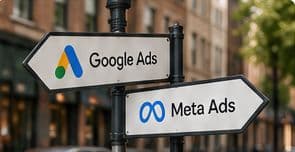
Google Ads and Meta Ads can both help local businesses reach potential customers, but they do it in very different ways.
The better choice depends on what you sell, how customers find businesses like yours, how quickly they make a decision, and what type of advertising content you can create.
For many businesses, the answer is not “Google or Meta.” It is understanding the role each platform can play.
The Main Difference: Search Intent vs. Audience Discovery
Google Ads often reaches people while they are actively searching.
Someone searching “emergency plumber near me” already has a clear need.
Meta Ads, which include advertising across Facebook and Instagram, often reach people while they are browsing content rather than actively searching for a service.
That creates a different type of opportunity.
Google can be strong when demand already exists.
Meta can be useful when the business wants to create awareness, stay visible, promote an offer, or reach a defined audience before they search.
When Google Ads Can Make Sense
Google Ads can work well for services where people search with strong intent.
Examples include:
- Plumbing
- Electrical services
- HVAC
- Roofing
- Legal services
- Dental services
- Physiotherapy
- Moving services
- Cleaning services
- Mortgage services
A user searching “roof repair Vancouver” is giving Google a strong signal about what they need.
That can make search advertising especially useful for businesses that solve specific problems.
Advantages of Google Ads
High-intent searches
Search campaigns can reach people who are already looking for a service.
Keyword targeting
Advertisers can choose search themes and keywords related to the services they provide.
Location controls
Campaigns can be targeted toward specific service areas.
Direct response
Search ads can send users directly to a service page, phone call, or enquiry form.
Challenges With Google Ads
Competition can make some keywords expensive.
A poorly structured campaign may spend money on irrelevant searches.
The landing page also matters. Even a strong campaign can struggle if the website is slow, unclear, or difficult to contact.
Ongoing review is important.
When Meta Ads Can Make Sense
Meta Ads are often useful when visual presentation, brand awareness, offers, or audience targeting matter.
Examples include:
- Salons
- Med spas
- Restaurants
- Gyms
- Clinics
- Home renovation businesses
- Real estate services
- Retail businesses
- Courses and training
- Local events
Meta can also help service businesses stay visible to people who may need the service later.
Advantages of Meta Ads
Visual creative
Photos, graphics, short videos, and AI-assisted creative can communicate an offer quickly.
Audience targeting
Campaigns can be built around location, broad interests, customer profiles, and platform signals.
Awareness and consideration
A business can reach people before they actively search.
Retargeting
Businesses can reconnect with people who have already visited the website or interacted with content, where platform policies and tracking setup allow.
Challenges With Meta Ads
People browsing Instagram or Facebook may not currently be looking for the service.
That means the creative has to earn attention.
Weak images, generic copy, or an unclear offer can make a campaign easy to ignore.
Meta campaigns often need more creative variation than search advertising.
Which Platform Is Better for Emergency Services?
For urgent needs, Google Search is often the more natural starting point because the customer is actively looking for help.
Examples include:
- Emergency plumbing
- Electrical problems
- Locksmith services
- Water damage
- Towing
That does not mean Meta is useless for these businesses. Meta may still support brand awareness, seasonal promotions, and retargeting.
But the customer journey is different.
Which Platform Is Better for Visual Businesses?
Meta can be especially useful when the service is easier to sell visually.
Examples include:
- Beauty services
- Renovations
- Interior design
- Restaurants
- Fitness
- Landscaping
- Cosmetic treatments
- Retail
Before-and-after content, short videos, visual offers, and branded creative can perform an important role in these campaigns.
Do You Need Separate Landing Pages?
Often, yes.
Sending every ad to a generic homepage is not always the strongest approach.
A dedicated landing page can keep the message focused.
For example, if an ad promotes furnace installation, the landing page should clearly discuss furnace installation rather than asking the visitor to navigate through every HVAC service.
A focused page can include:
- Clear headline
- Service explanation
- Relevant proof
- Service area
- Contact action
- Common questions
What About Budget?
There is no universal ad budget that makes sense for every business.
Budget depends on:
- Market size
- Competition
- Average job value
- Customer lifetime value
- Search demand
- Creative quality
- Sales process
- Location
- Campaign objective
Instead of choosing a budget based on what another company spends, start with the economics of your own business.
Should a Local Business Use Both?
Sometimes.
One common approach is to use Google Ads to capture active demand and Meta Ads to build awareness, promote visual offers, or retarget interested visitors.
But running both platforms is not automatically better.
A business with a limited budget may get more useful information by starting with one channel, measuring performance, and expanding later.
Measure Business Outcomes, Not Vanity Metrics
Clicks, impressions, and video views can be useful signals, but they are not the final goal for most local service businesses.
Track outcomes such as:
- Calls
- Enquiries
- Bookings
- Qualified leads
- Cost per enquiry
- Revenue where accurate attribution is available
Do not assume that a campaign with more clicks is automatically better.
Final Thoughts
Google Ads and Meta Ads solve different advertising problems.
Google is often strongest when customers are already searching.
Meta can be powerful when the business needs visual storytelling, audience discovery, awareness, or retargeting.
The right choice depends on the customer journey.
Shoobook helps businesses plan and manage paid advertising across Google and Meta, along with the creative and landing-page support needed to make campaigns clearer and more effective.
RELATED PAGES: Advertising & Paid Campaigns: /advertising Content Creation: /content Website Design & Development: /websites Contact: /contact